I remember the beginning of winter’s in 2008 like a broken dream. I was not yet ten when my family’s village in Bajaur came under attack. Under deafening bombs we were rushed onto lorries bound for Peshawar. Overnight we became one of the many families living in tents and donated tarps. Official counts later put our displacement at roughly a quarter-million people, mostly Pashtun mothers, children and the elderly. I vividly recall a man in camp crying out to the soldiers: “What wrongs have our children, women, and cattle committed?” as he begged them to hit only the militants, not the civilians. We had left everything behind, watching entire valleys emptied, yet heard only the vague promise that this was to eliminate the insurgents.
For years afterward we idled in camps or crowded shacks, living on charity and government rations. By the time we tentatively returned, our old home was a ruined shell its roof smashed in, walls riddled with bullet holes with no government compensation in sight. We still thought those operations were over. But history, it seems, had other plans.
Back to Khyber: A Familiar Exodus
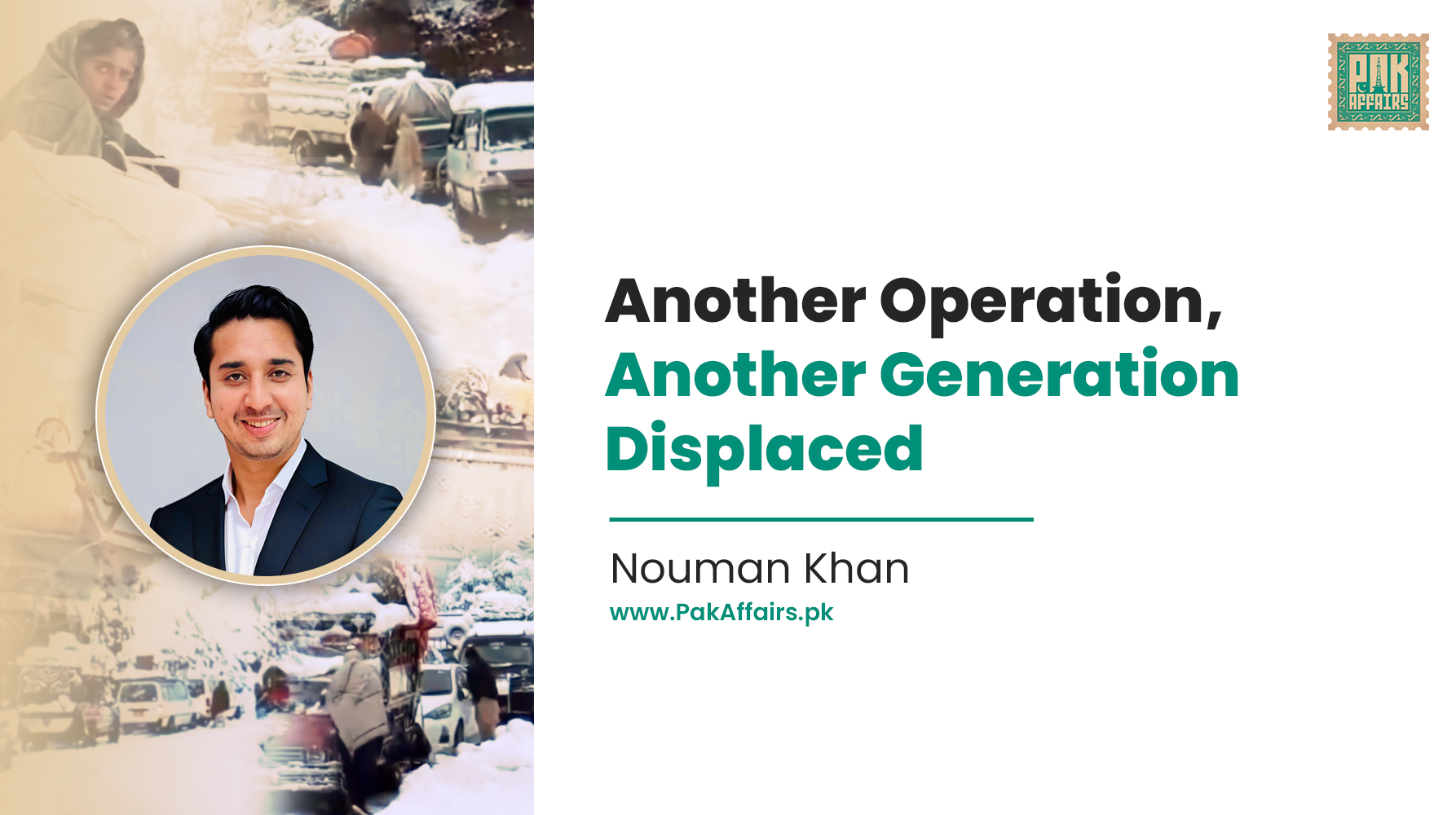
Now, nearly two decades later, I watch it all over again in Khyber district. This winter the federal government ordered another mass evacuation, this time of the Tirah Valley. Some 150,000 people were told to leave by January 25, 2026, as the army launched raids against Taliban militants there. Within days an estimated 80,000 residents had fled toward Peshawar, packing into buses and trucks on winding mountain roads.
I see once-quiet fields now choked with idling cars and loaded carts. Families sit huddled on freezing slopes, children wrapped in shawls against the cold. On the news came a heartbreaking story: a young boy in a vehicle turned acutely ill, and by the time his family pleaded to have the road cleared for him, the child had died in the snow.
These scenes are chillingly familiar. Many of the Kukikhel and Zakhakhel tribesmen displaced in past operations had only just rebuilt homes in Tirah. Last year, thousands from Tirah staged protests at the border road demanding to return, they even blocked the strategic Torkham Highway for weeks. They make the same plea they did before: an army spokesman claims the entire 46,000 square kilometers of former tribal land has been cleared of militants and lauds an “important and successful operation” in Tirah. Yet the protesters ask: if the valley is indeed safe, why are we frozen out of our own homes? Reports say more than 6,000 displaced families want to go back, but no clear answer is given. Instead, the cycle spins on: Kaboom. Flee. Void. Repeat.
Decades of Failed Offensives
This pattern should not surprise me. Pakistan’s chain of tribal-area wars stretches back generations. The military boasts of each campaign as decisive, but analysts are skeptical. In the past twenty years we have seen well over twenty major operations in the northwest. Each time, after bomb blasts and house-to-house searches, soldiers eventually return to barracks, and the militants often drift back across the porous border or hide in the peaks. Consider North Waziristan in 2014: Operation Zarb-e-Azb drove nearly one million people from their homes under the promise of clearing the Taliban. A year on, a displaced man told reporters that officials kept saying “we have cleared the area… we will get [the IDPs] back soon” – and ended up admitting “they are lying” about any swift return. Similarly, in 2009 the South Waziristan offensive uprooted hundreds of thousands, most of whom still have not returned.
In fact, as one local analyst noted, “very few areas…have not been declared cleared of militants,” yet the army has to stage another operation in those same valleys again. In our hills, the same villages have changed hands like game pieces. Time after time we watch expectations raised the next generation promised peace only to see rockets fly and know it will be our children’s generation left to flee once more.
The Civilian Toll
All the while, it is the ordinary people who pay the price. Decades of fighting have turned scores of villages to rubble and minds to stone. Men who once farmed wheat or ran shops now sit idle. A refugee camp interview from North Waziristan quoted one father: “There is no work here, no income, I cannot even afford to send my kids to school”. Across the tribal belt, roughly 1.4 million people remain internally displaced by these conflicts. Think of that: nearly a million and a half men, women and children still unable to safely go home years after the war.
Those who do return often find nothing left. A 25-year-old returnee to Tirah recounted that in 2019 “we were unable to recognize our houses” – everything had been destroyed – and added bitterly that her family “received no compensation for their losses”. In Mir Ali, a trader pointed out that all 60 shops in one local bazaar had been leveled by bombs and bulldozers. “We never got any compensation,” the community spokesman said, despite a dozen years of losing homes and livelihoods.
Everywhere I’ve been, the trauma lingers in haunted eyes: mothers rocking hungry babies at midnight, teenagers mute with shock, and the elderly racked with worry over debts they can’t pay. Even lawmakers have been moved: one Pashtun leader asked parliament, with tears in his voice, whether driving people from their homes in winter was any different from terrorism. As a doctor told me quietly, we are witnessing untreated wounds over generations.
Breaking the Cycle
The government says it understands the pain. In fact, even the provincial leadership has begun to admit that throwing soldiers at this problem is not enough. Khyber-Pakhtunkhwa’s chief minister recently vowed not to follow any “failed policy” and insisted that lasting peace can only come through consulting tribal elders and the provincial government. A jirga echoed that sentiment: we need “all stakeholders… on the same page” to normalize this situation. These words are welcome. The next steps must be concrete. Islamabad should back them up by urgently rebuilding what has been lost: proper housing, schools and hospitals, and real compensation for victims. Unemployment and injustice are the true fuel for these insurgencies, we need jobs, education, and courts where Pakhtun have confidence they will get justice, not endless military sweeps.
Above all, politicians and generals should listen to the people they aim to protect. We have heard promises of “development schemes” and funds for the merged districts, but years later many on the ground see only teargas and silence. The residents of Tirah, like those of Bajaur and Waziristan before them, do not ask for much: simply the right to live on their land in peace. If the state can secure that without constant war by acting justly, building bridges instead of bunkers, and including Pashtun voices in every decision, then maybe this cycle will finally end.
I carry the memory of Bajaur and the lessons of the past with every press pass I pin on my coat. Pakistan’s future will be measured by whether children today grow up with textbooks under their arms or the next bomb alert on their phones. Our tribal provinces have endured more than enough. It is high time for real change one that is rooted in justice, development, and the dignity of every displaced family, not just in yet another short-lived military campaign.